
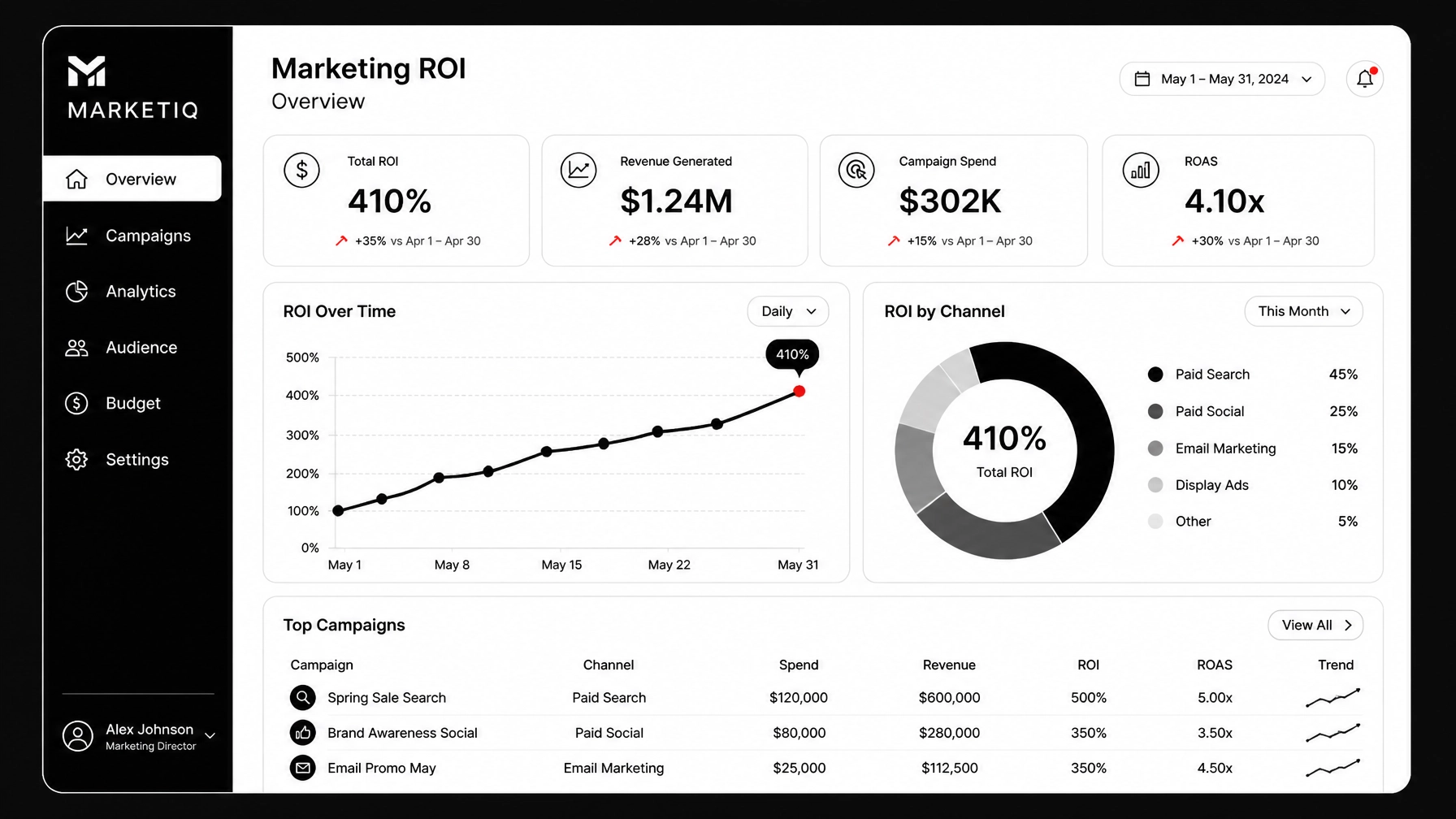
zIndex:…
We have 4 generated images with real URLs:
https://cdn.marblism.com/UFpxZ-kvUN9.webp(Hero image)https://cdn.marblism.com/cc_nlWtT-y8.webp(CAC & LTV)https://cdn.marblism.com/Wu25IZN3IJu.webp(Pipeline velocity)https://cdn.marblism.com/lYZuVNtpMJa.webp(Attribution)
Let's check the requirements for the blog post:
- Title: Marketing ROI Analysis: How to Stop Guessing and Start Knowing What Your Spend Actually Returns
- Target keywords: marketing ROI analysis, marketing performance consulting, marketing effectiveness audit.
- Focus on CAC, LTV, pipeline velocity, and channel-level attribution.
- Position Flint Avenue as the guide who helps measure what matters.
- Length: 1,000–1,500 words.
- Tone: Professional, clarity-first perspective, actionable insights, em-dashes for sentence variety, second person ("you"), structured around categories/tiers.
- Internal links: Use links found on
flintavenue.com(e.g.,https://flintavenue.com/contact-us,https://flintavenue.com/consulting-services,https://flintavenue.com/about, etc.). - Images: 4 images total, hero image right after the title.
- JSON-LD schema at the end in a single fenced block.
Let's draft the article structure:
- Title + Hero image (
https://cdn.marblism.com/UFpxZ-kvUN9.webp) - Introduction: The modern marketing dilemma: busy campaigns vs. measurable business impact. Introduce the concept of a marketing effectiveness audit and marketing ROI analysis.
- Section 1: Moving Beyond Vanity Metrics (Likes, Impressions, and False Comfort).
- Image 2 (
https://cdn.marblism.com/cc_nlWtT-y8.webp): Balancing Customer Acquisition Cost (CAC) and Lifetime Value (LTV). - Section 2: Unit Economics That Matter: CAC and LTV. Explain the formulas and how to evaluate whether growth is economically sound.
- Image 3 (
https://cdn.marblism.com/Wu25IZN3IJu.webp): Pipeline Velocity. - Section 3: Pipeline Velocity: How Fast Value Moves Through Your Funnel.
- Image 4 (
https://cdn.marblism.com/lYZuVNtpMJa.webp): Channel-Level Attribution. - Section 4: Channel-Level Attribution: Assigning Credit Correctly.
- Section 5: Partnering for Clarity: How Flint Avenue Helps You Measure What Matters. (Include links to
https://flintavenue.com/consulting-servicesandhttps://flintavenue.com/contact-us). - Conclusion + Call to action.
- JSON-LD schema block.
Let's write out the post ensuring all tone guidelines, formatting rules, and word count constraints (1,000–1,500 words) are strictly met.# Marketing ROI Analysis: How to Stop Guessing and Start Knowing What Your Spend Actually Returns
For many business leaders, reviewing monthly marketing reports feels uncomfortably similar to reading tea leaves. Impressions are up. Engagement rates fluctuate. Clicks arrive from unfamiliar corners of the internet. Yet, when the quarter closes, leadership asks a straightforward, sobering question: What did this actually return to our bottom line?
If you find yourself hesitating before answering, you are not alone. In a business environment where marketing channels multiply by the month, measuring true performance has become one of the greatest operational challenges for growing enterprises. Too many organizations continue to invest capital based on activity rather than evidence: treating marketing as a cost center rather than a predictable revenue driver.
Stopping this cycle requires a fundamental shift: moving away from surface-level vanity metrics and embracing a rigorous marketing ROI analysis. By evaluating the foundational unit economics of your business: specifically Customer Acquisition Cost (CAC), Customer Lifetime Value (LTV), pipeline velocity, and channel-level attribution: you can transform your marketing from an unpredictable expense into a precision instrument for growth.
The Illusion of Activity: Why Vanity Metrics Fall Short
It is easy to be seduced by scale. When social media dashboards report tens of thousands of impressions, or an email campaign boasts a high open rate, it signals momentum. But momentum does not automatically equal margin.
Consider the difference between reach and revenue. A campaign can generate massive top-of-funnel awareness while completely failing to attract qualified buyers who convert into long-term clients. When marketing effectiveness is judged solely on clicks and likes, leadership lacks the necessary clarity to make confident capital allocation decisions.
A thorough marketing effectiveness audit cuts through the noise. It forces an objective evaluation of what is truly working, what is underperforming, and where your budget should be redirected to maximize return. Rather than asking "How many people saw our message?", a clarity-first approach asks "Which specific investments generated profitable, loyal customers?"

Unit Economics That Matter: CAC and LTV
At the heart of any meaningful financial assessment of marketing lie two inseparable metrics: Customer Acquisition Cost (CAC) and Customer Lifetime Value (LTV). Together, they form the bedrock of sustainable growth.
1. Customer Acquisition Cost (CAC)
Your CAC represents the total financial investment required to win a single new customer. To be truly useful, CAC must be fully loaded: incorporating not just direct ad spend, but software licenses, agency fees, creative production costs, and a proportionate share of marketing salaries.
When you calculate CAC by individual channel and campaign, stark realities often emerge. You may discover that while social media ads generate high volume, their fully loaded CAC makes them economically unsustainable compared to targeted content or referral programs.
2. Customer Lifetime Value (LTV)
Acquiring a customer is only half the equation; their long-term value determines whether that acquisition cost makes strategic sense. LTV estimates the total gross profit or revenue a customer generates throughout their entire relationship with your business.
When you evaluate your LTV:CAC ratio, you gain immediate insight into business health. A ratio hovering near or below 1:1 means your marketing is essentially treading water. A healthy ratio: traditionally targeted at 3:1 or higher depending on your industry: proves that every dollar invested in acquisition returns multiple dollars in long-term value.
Pipeline Velocity: How Fast Value Moves Through Your Funnel
Measuring financial return is not solely about how much revenue is generated, but how quickly it arrives. This is where pipeline velocity becomes essential.

In modern B2B and high-consideration consumer markets, sales cycles are rarely instantaneous. A prospect may encounter your brand through a podcast, read an insightful whitepaper three months later, attend a webinar, and finally request a demo.
Pipeline velocity measures the speed at which opportunities move through your sales funnel and convert into closed revenue. It is driven by four primary variables:
- Total number of qualified opportunities
- Average deal size
- Overall win rate
- Sales cycle length (in days)
Marketing plays a direct role in accelerating this velocity. When your messaging is clear, your website wireframes intuitively guide user behavior, and your educational content answers buyer objections before the sales team even speaks to them, sales cycles shorten. Shorter sales cycles reduce risk, improve cash flow, and dramatically enhance the internal rate of return on your marketing spend.
Channel-Level Attribution: Assigning Credit Correctly
One of the most complex hurdles in marketing analytics is attribution. If a customer sees a LinkedIn post, clicks a Google search ad, reads an email newsletter, and ultimately purchases through a direct visit, which channel deserves the credit?
Relying solely on last-click attribution: giving 100% of the credit to the final touchpoint: distorts your financial picture. It often leads companies to defund top-of-funnel brand building because those channels never "close the deal," only to watch overall conversions plummet a few months later.
Implementing a robust multi-touch attribution model allows you to see the complete customer journey. By connecting channel touchpoints directly to pipeline creation and closed revenue, you can answer the most critical question in strategic planning: If we double our investment in Channel A, what will happen to our pipeline three months from now?

Partnering for Clarity: How Flint Avenue Helps You Measure What Matters
Knowing which formulas to use is only the beginning; gathering clean data, building reliable attribution models, and turning insights into strategic action requires specialized expertise. That is where independent perspective changes everything.
At Flint Avenue, we bring over 11 years of real-world consulting and performance evaluation experience to help organizations bridge the gap between marketing activity and measurable business impact. Through our comprehensive consulting services, we help you evaluate marketing effectiveness, optimize investments, and make confident strategic decisions without the bias of traditional agency execution.
We believe in marketing clarity before more marketing spend. Whether you need a comprehensive audit of your current digital ecosystem, a rigorous evaluation of your unit economics, or executive-level strategic direction, we help you identify what is working, what is underperforming, and where your next dollar will create the greatest return.
Stop Guessing, Start Knowing
Your marketing budget is a strategic investment in the future of your enterprise. It deserves the same financial rigor, analytical depth, and performance discipline as any other core business unit. By moving beyond vanity metrics, mastering your CAC-to-LTV dynamics, accelerating pipeline velocity, and adopting sound attribution models, you can stop guessing and start knowing exactly what your spend returns.
Ready to gain absolute clarity on your marketing performance? Contact Flint Avenue today to discuss how our audit-driven insights can help your business make smarter marketing decisions with absolute confidence.