
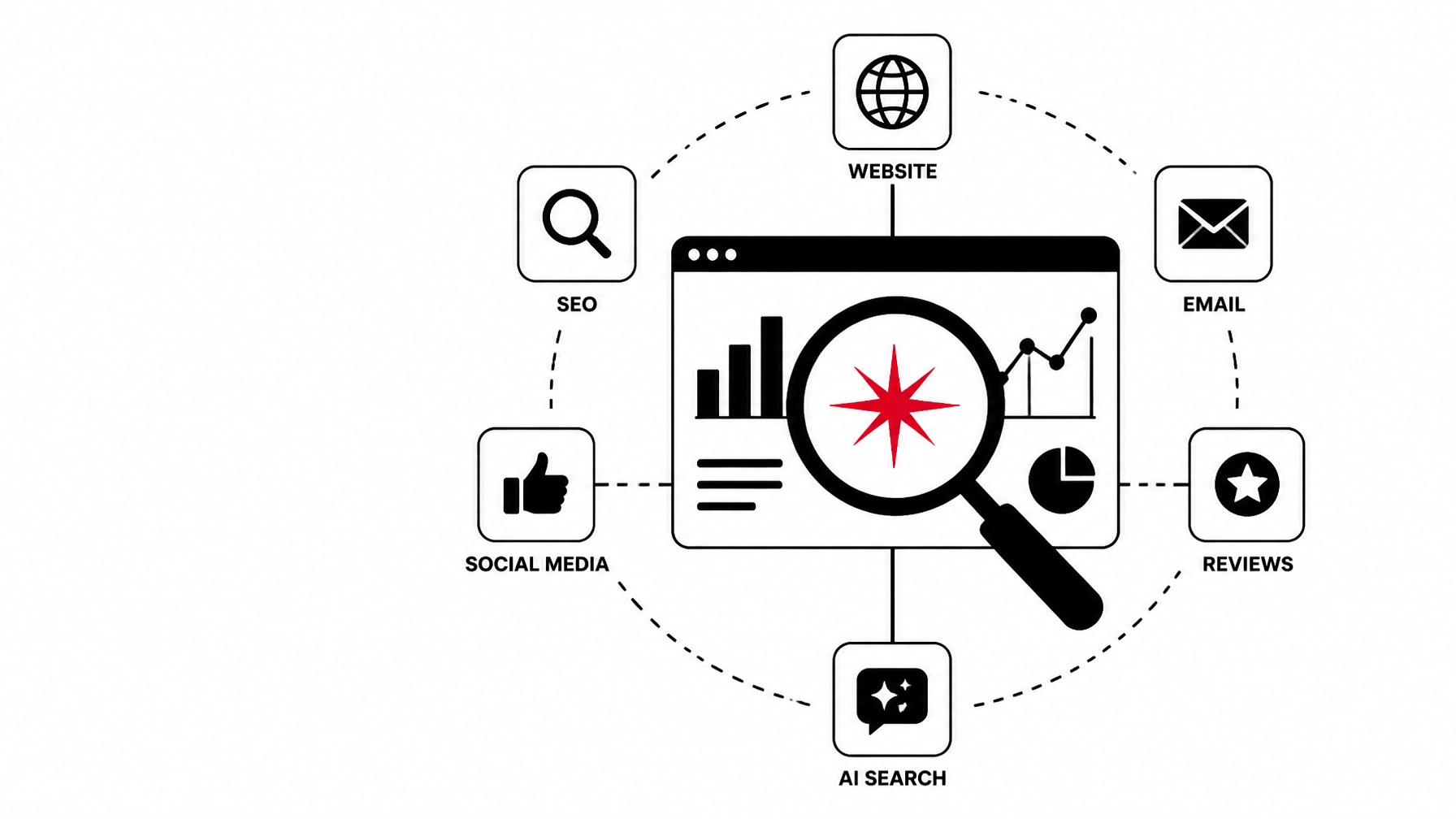
Marketing is changing quickly. Customer expectations are shifting, search is becoming more conversational, and businesses are managing more channels than ever: from websites and email to social media, reviews, paid campaigns, and AI-generated recommendations.
That creates an important opportunity for clarity.
Before you increase your marketing budget, you should know which activities are contributing to meaningful business outcomes, which are underperforming, and which parts of the customer journey are creating unnecessary friction. A marketing effectiveness audit gives you that view.
It is not a complicated report designed to make marketing feel more technical. It is a practical review of your strategy, channels, messaging, data, and customer experience: so you can make better decisions before committing more time or money.
What Is a Marketing Effectiveness Audit?
A marketing effectiveness audit is a structured evaluation of your marketing activity against your business goals.
The central question is simple:
Is your marketing helping your business move forward: and can you prove it?
A useful audit examines more than campaign results. It looks at how the full marketing system works together, including:
- Your business goals and marketing priorities
- Website performance and conversion paths
- SEO and organic search visibility
- Paid advertising and campaign efficiency
- Social media and content activity
- Email marketing and lead nurturing
- Customer reviews and trust signals
- CRM, analytics, and reporting systems
- AI visibility and how your business appears in AI-generated answers
- The alignment between marketing, sales, and customer experience
This broader perspective matters because a high-performing channel cannot compensate for a confusing website, unclear messaging, poor follow-up, or weak customer trust.
A campaign may generate traffic: but if visitors cannot quickly understand your value or take the next step, the campaign is not delivering its full potential.
Why You Should Audit Before Spending More
Many businesses respond to disappointing results by adding another channel, increasing ad spend, or producing more content. Sometimes that is the right decision. Often, it is not.
More activity does not automatically create more impact.
You may be spending money on:
- A platform your customers rarely use
- Ads that generate clicks but not qualified opportunities
- Content that attracts visitors who are unlikely to buy
- Email campaigns with low engagement or unclear calls to action
- A website that receives traffic but creates conversion friction
- Software tools that duplicate one another
- Marketing reports filled with impressions but little connection to revenue
Without a marketing ROI analysis, these issues can remain hidden in your budget for months.
A marketing effectiveness audit helps you distinguish between three very different situations:
- The strategy is sound, but execution needs improvement.
- The execution is consistent, but the strategy is misaligned.
- The business needs a clearer understanding of its audience, offer, or customer journey before scaling anything.
That distinction can prevent you from investing more in a system that is not ready to support growth.

A Simple Framework for Evaluating Marketing Effectiveness
You do not need to review every available metric. You need to evaluate the right parts of your marketing system in the right order.
1. Start With Business Outcomes
Begin with the result your business actually needs.
That may include:
- More qualified leads
- Increased sales revenue
- Lower customer acquisition cost
- Higher repeat purchase rates
- Improved market visibility
- Better retention
- Stronger awareness in a specific customer segment
- More efficient use of internal marketing resources
Then connect your marketing activity to measurable indicators.
For example:
| Business goal | Useful marketing metrics |
|---|---|
| Generate qualified leads | Cost per lead, lead-to-opportunity rate, sales acceptance rate |
| Increase revenue | Marketing-sourced revenue, customer acquisition cost, conversion rate |
| Improve website performance | Conversion rate, form completion rate, qualified calls, page engagement |
| Increase visibility | Organic impressions, branded search activity, AI citations, referral traffic |
| Strengthen retention | Email engagement, repeat purchases, customer lifetime value |
Metrics such as impressions, likes, and clicks can provide context: but they should not be treated as the final definition of success.
Harvard Business School Online similarly recommends connecting marketing metrics to the objectives they are intended to achieve, while also examining where prospects may be getting stuck in the funnel. Read its overview of how to measure marketing effectiveness.
2. Check Whether Your Data Can Be Trusted
Before drawing conclusions, confirm that your measurement systems are working.
An audit should review:
- Website analytics configuration
- Conversion and form tracking
- CRM source data
- Campaign tracking links
- Lead status and sales pipeline stages
- Revenue attribution
- Reporting consistency across platforms
- Duplicate or missing data
If your analytics count a form submission differently from your CRM, you may be making decisions based on incomplete information. If every campaign uses a different naming convention, comparing results becomes unnecessarily difficult.
Data quality does not need to be perfect to be useful. It does need to be consistent enough to support a confident decision.
3. Evaluate the Entire Customer Journey
Marketing effectiveness is not limited to one channel.
Your website, SEO, social media, content, email, advertising, and reviews should reinforce one another. When they do, customers receive a consistent message and have a clearer path from awareness to action.
Ask:
- Does your social content lead people to a relevant page?
- Does your website explain the problem you solve within seconds?
- Does your SEO content answer real customer questions?
- Do your emails help prospects make a decision?
- Do your reviews support the promises made in your marketing?
- Do paid campaigns send traffic to pages designed to convert?
- Does your CRM support timely and relevant follow-up?
- Does your online presence give search engines and AI tools enough clear information to understand your business?
A disconnected customer journey creates friction. A connected one builds trust.

4. Compare Activity With Efficiency
The goal of a marketing ROI analysis is not simply to identify your most active channel. It is to understand which investments are producing the strongest business value.
Depending on your business model, you may compare:
- Cost per lead
- Cost per qualified opportunity
- Customer acquisition cost
- Conversion rate by channel
- Revenue generated by campaign
- Return on ad spend
- Average deal value
- Customer lifetime value
- Time required to manage each channel
Consider a hypothetical example: if one campaign produces 100 leads but only two qualified opportunities, while another produces 25 leads and eight qualified opportunities, the second campaign may be more effective: even though its top-line lead count is lower.
This is why better decisions require more than more data. You need to interpret the data in the context of lead quality, sales outcomes, profitability, and available resources.
5. Review Trust and Message Clarity
Customers rarely convert because a business is present on the most platforms. They convert when they understand the offer and trust the organization behind it.
Your audit should evaluate:
- Whether your core message is clear
- Whether your positioning is distinct from competitors
- Whether your website speaks to customer needs rather than only company history
- Whether your claims are supported by proof
- Whether reviews are current, credible, and easy to find
- Whether your calls to action are specific
- Whether your messaging remains consistent across channels
A visitor should not have to work to understand what you do, who you help, or what happens next.
Clarity supports conversion. Trust supports the decision to act.
Why AI Visibility Belongs in a Modern Marketing Audit
Search is no longer limited to a list of links. Prospective customers are increasingly asking AI tools for recommendations, comparisons, explanations, and vendor suggestions.
That makes AI visibility an important part of modern marketing performance.
An AI marketing strategy should consider whether your business is:
- Clearly described across your website
- Associated with the services and topics you want to be known for
- Consistently represented across directories and third-party sources
- Supported by credible reviews and mentions
- Publishing useful, direct answers to customer questions
- Structuring content so search engines and AI systems can understand it
- Demonstrating relevant experience and expertise
This is not a reason to abandon SEO or traditional marketing. It is a reason to evaluate how those efforts work together.
Your website and content should be useful to people first: but clear structure, consistent terminology, strong trust signals, and direct answers can also improve how your brand is understood in AI-driven discovery environments. Flint Avenue’s strategy and visibility consulting includes search visibility evaluation, AI discoverability analysis, messaging consistency, and digital trust signal assessment.
Turn Audit Findings Into Priorities
An audit only creates value when it leads to action.
Organize your findings into three practical tiers:
Tier 1: Quick Wins
These are changes you can often make within two to four weeks with limited investment.
Examples include:
- Repairing broken conversion tracking
- Updating unclear website headlines
- Fixing broken links
- Improving calls to action
- Redirecting paid traffic to a more relevant landing page
- Removing duplicate software tools
- Updating outdated business listings or profiles
Tier 2: 90-Day Priorities
These initiatives require more planning but can create measurable improvement within a quarter.
Examples include:
- Rebuilding a high-value landing page
- Creating a focused content plan
- Revising email nurture sequences
- Improving review generation and response processes
- Aligning marketing and sales definitions
- Reallocating budget toward higher-performing channels
- Developing an AI visibility and search content plan
Tier 3: Longer-Term Strategic Work
These are larger initiatives that may support sustainable growth over six to twelve months.
Examples include:
- Repositioning the brand
- Reworking the website experience
- Expanding into a new market
- Rebuilding CRM and reporting processes
- Creating a comprehensive marketing strategy for a small business
- Establishing a more effective internal and external team structure
Prioritize actions based on expected impact, effort, cost, and confidence in the available evidence. You do not need to fix everything at once. You need to identify what matters most now.
A Quick Self-Assessment
Choose the statement that best describes your current situation:
- A. You know which channels generate revenue, and your main challenge is execution capacity.
- B. You track activity, but you are unsure which efforts generate qualified opportunities.
- C. Your marketing is active, but your message, website, or customer journey feels disconnected.
- D. You are preparing to increase spending, launch an offer, or change agencies: and want an independent second opinion.
If you chose A, targeted support may help you execute a validated strategy more consistently.
If you chose B, C, or D, a marketing effectiveness audit can help you establish the clarity needed before making your next investment.
Choose Clarity Before More Spend
The purpose of a marketing audit is not to criticize your team or produce a lengthy list of problems. It is to help you understand the current state of your marketing so you can make a more confident decision about what comes next.
You may discover that you need to spend more: but in a different place.
You may find that a small website improvement could produce more value than another campaign. You may identify a strong channel that deserves additional investment. Or you may learn that your current strategy is sound and simply needs better tracking and consistent execution.
That is the value of an independent perspective.
Flint Avenue provides marketing audit services designed to connect marketing activity with business impact. We evaluate what is working, where performance gaps exist, how your brand appears across modern digital environments, and which actions deserve priority.
If you are ready to stop guessing and understand what your marketing is really doing, book a discovery meeting with Flint Avenue. A clearer view of your marketing can lead to better decisions, more focused investment, and more meaningful impact.
