
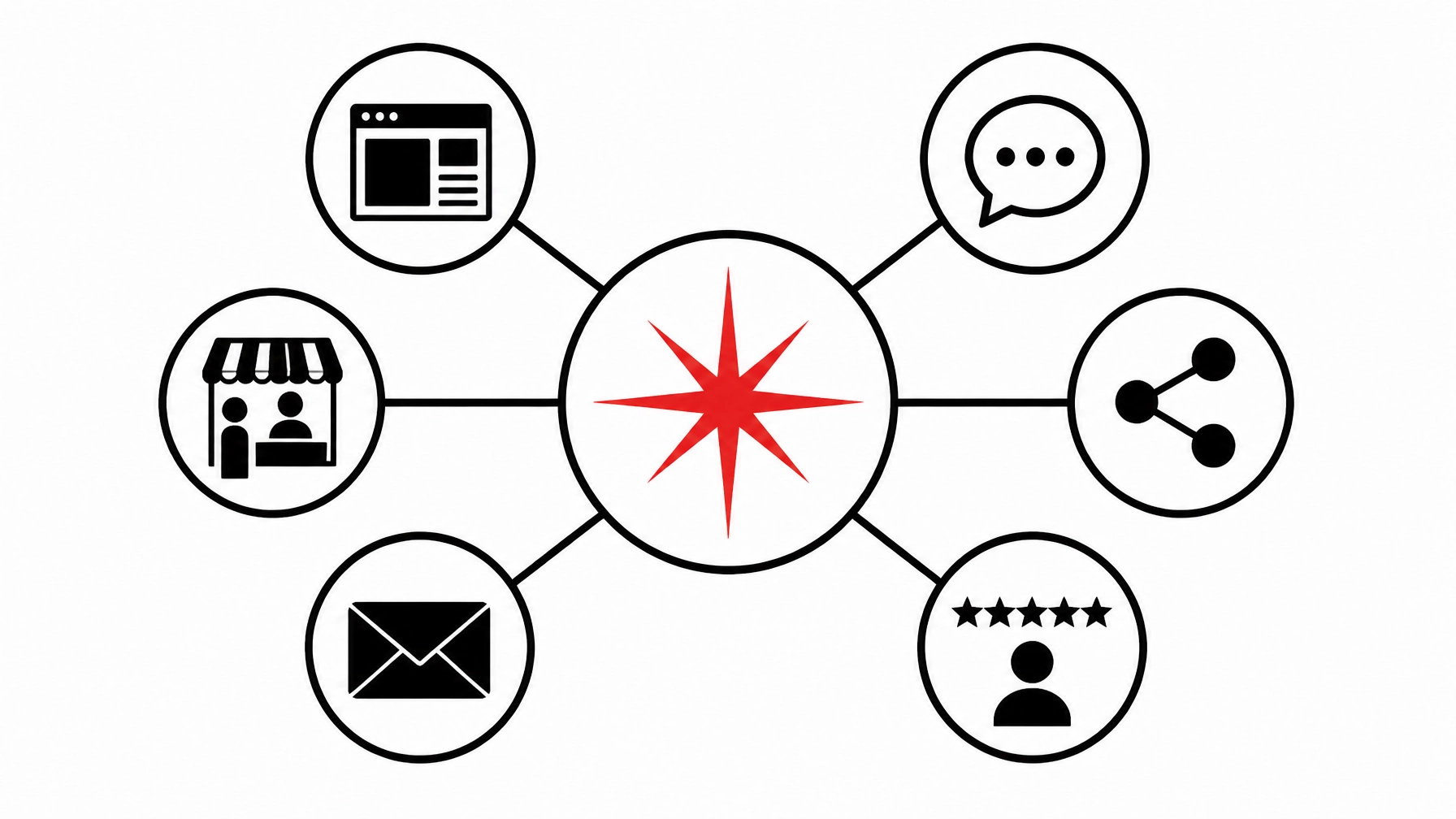
Customer experience is no longer limited to what happens after someone makes a purchase. It begins the moment a potential customer encounters your name: and continues through every search result, website visit, social interaction, review, email, conversation, transaction, and follow-up.
That means every touchpoint is doing one of two things: building trust or quietly costing you customers.
A clear website can reduce hesitation. A confusing message can create doubt. A thoughtful review response can reinforce credibility. A delayed email or disconnected sales experience can undermine it. These moments may seem separate inside your business, but customers experience them as one connected journey.
This is where customer experience consulting becomes valuable. The goal is not to add more marketing activity. It is to understand how your existing touchpoints work together, where friction exists, and which improvements are most likely to create meaningful impact.
Trust Is a Business Outcome: Not Just a Brand Attribute
Trust can sound like an abstract branding goal until you connect it to measurable results.
According to research summarized by Zendesk, 87% of consumers trust a company more when it provides an excellent customer experience. HubSpot research has also found that customers expect service issues to be resolved within approximately three hours or less. These expectations affect whether people buy, return, recommend your business, or move on.
A positive experience can also create lasting financial value. Research cited by Nicereply reports that 93% of consumers are more likely to make a repeat purchase from a company that provides excellent customer service.
The practical takeaway is simple: customer experience affects conversion and retention because it reduces perceived risk. When your messaging is clear, your process is predictable, and your proof is easy to find, customers have fewer reasons to hesitate.
The Six Touchpoints Customers Use to Judge Your Business
Customer experience consulting looks beyond individual channels. It evaluates the full system of interactions that shape how customers understand and remember your business.
1. Your Website: The First Handshake
For many customers, your website is the first direct interaction they have with your company. It must answer key questions quickly:
- Who do you serve?
- What problem do you solve?
- Why should someone choose you?
- What should the visitor do next?
If visitors cannot answer those questions within a few seconds, they may assume your business is not a fit: even if your actual product or service is excellent.
Your website should also provide proof. Reviews, case studies, credentials, frequently asked questions, and clear contact information help reduce uncertainty. Navigation, mobile usability, page speed, and accessibility matter as well. Research summarized by Contentful found that ecommerce sites loading in one second can achieve conversion rates 2.5 times higher than sites taking five seconds.
A website evaluation should therefore examine more than appearance. It should connect website behavior to outcomes such as:
- Conversion rate
- Form completion rate
- CTA click-through rate
- Time spent on key pages
- Mobile drop-off
- Calls or inquiries generated
2. Messaging: The Meaning Behind the Experience
Customers do not experience your brand through design alone. They experience it through the words you use to explain your value.
A strong brand positioning strategy helps your business communicate what makes it relevant and different. Without clear positioning, your website, social profiles, emails, and sales conversations may all describe the company differently.
That inconsistency creates a subtle trust problem. A customer may see one promise in an advertisement, another on your website, and a third in a sales conversation. Even when each message sounds reasonable, the overall experience feels uncertain.
Review your messaging for consistency across:
- Headlines and service descriptions
- Calls to action
- Social media bios
- Sales presentations
- Email subject lines
- Review responses
- Printed materials and signage
Clarity does not mean making your message generic. It means making your value easier to understand and easier to remember.

3. Social Media and Content: Evidence of Relevance
Social media often functions as a public preview of what it is like to interact with your company.
Customers look for signs that your business is active, knowledgeable, responsive, and aligned with their needs. They may review your recent posts before contacting you. They may also judge your responsiveness based on how you answer comments and direct messages.
The strongest social and content strategies do not simply promote products. They demonstrate usefulness. Educational content, practical guidance, customer stories, and transparent answers help prospective customers see how you think and how you work.
Track more than reach and impressions. Consider:
- Traffic from social platforms to your website
- Qualified inquiries
- Engagement from target audiences
- Direct-message response time
- Content-assisted conversions
- Questions and concerns repeated by prospects
These patterns can reveal opportunities to improve your broader marketing strategy for small business or larger organizations.
4. Reviews: The Trust You Do Not Fully Control
Reviews are one of the most influential third-party touchpoints because they allow prospective customers to see how others experienced your business.
Review volume and star ratings matter, but the content matters just as much. Customers often look for repeated themes related to communication, reliability, ease, responsiveness, and problem resolution.
Your response process is also part of the customer experience. A thoughtful response to a negative review can demonstrate accountability. A defensive or generic reply may reinforce the original concern.
Build a review process that includes:
- Asking appropriate customers for honest feedback.
- Monitoring reviews across relevant platforms.
- Identifying recurring issues.
- Responding with empathy and specificity.
- Sharing legitimate proof on your website and sales materials.
Reviews should not be treated as a separate reputation task. They are feedback about the full customer journey.
5. Email: The Experience Between Transactions
Email can strengthen trust: or make your business feel impersonal and disorganized.
A useful email experience sets expectations and makes the next step obvious. This applies to welcome emails, appointment confirmations, onboarding instructions, purchase updates, newsletters, renewal notices, and feedback requests.
Ask yourself:
- Does the customer know why they received this message?
- Is the next action clear?
- Does the email match the promise made elsewhere?
- Are customers receiving information at the right time?
- Is the tone appropriate for the relationship?
Email performance should be evaluated beyond open rates. Look at click-through rates, unsubscribe rates, replies, conversions, appointment attendance, repeat purchases, and customer feedback.
In many organizations, small improvements: such as clearer onboarding or better follow-up timing: can create more value than sending more campaigns.
6. The Physical and Human Experience
For businesses with offices, retail spaces, events, service teams, or face-to-face interactions, the physical experience must support the digital promise.
If your website describes a simple, welcoming process but the in-person experience is difficult or confusing, customers will remember the disconnect. The same is true when employees lack the information or authority needed to resolve common issues.
Evaluate practical details such as:
- Ease of scheduling
- Arrival and check-in
- Wait times
- Staff communication
- Environment and signage
- Service consistency
- Resolution time
- Follow-up after an issue
Customer experience consulting helps connect these operational moments to your broader brand positioning. Trust is built when the experience feels consistent: regardless of whether the customer is on your website or standing in front of your team.
Fix the Journey, Not Just the Touchpoint
A common mistake is improving individual channels without examining what happens between them.
For example, your social media may promote a service clearly, but the link may lead to a website page with different language. Your website may generate a lead, but the follow-up email may take several days. A customer may receive an excellent sales experience, but the onboarding process may be unclear.
These gaps create friction in the handoffs.
A practical customer journey review should map:
- Awareness: search, social, referrals, advertising, and content
- Consideration: website pages, reviews, case studies, and conversations
- Conversion: forms, calls, proposals, checkout, or scheduling
- Delivery: onboarding, fulfillment, support, and communication
- Retention: follow-up, renewal, loyalty, referrals, and advocacy

A Clarity-First Self-Assessment
Choose the answer that best describes your business:
A. Customers receive a consistent message and clear next steps across most channels.
B. Each channel works independently, but the overall journey feels disconnected.
C. You are not sure what customers see, experience, or do between first contact and purchase.
If you chose B, start by reviewing the transitions between channels.
If you chose C, begin with a focused assessment before investing in more campaigns, software, or content. A marketing effectiveness audit can help identify where customer experience gaps are affecting performance.
Three Practical Next Steps
1. Create a Touchpoint Inventory
List every place a customer may encounter your business: from Google results and social profiles to proposals, invoices, support emails, and physical signage.
For each touchpoint, record:
- The customer’s likely question
- The message they receive
- The action you want them to take
- The person or team responsible
- The metric that indicates success
2. Identify One Friction Point Per Journey Stage
Do not try to fix everything at once. Look for the highest-impact obstacle in awareness, consideration, conversion, delivery, and retention.
Examples include:
- A homepage that does not explain the offer
- A contact form that asks for too much information
- Reviews that are not being answered
- A slow response after a lead submits an inquiry
- An onboarding process with unclear expectations
Prioritization is essential to a useful strategic marketing plan. More activity is not automatically better activity.
3. Connect Experience Improvements to Business Metrics
Use a practical measurement framework. Track the metrics that show whether trust and clarity are improving:
- Qualified lead conversion rate
- Cost per qualified lead
- Proposal acceptance rate
- Customer satisfaction
- Response and resolution time
- Repeat purchase or renewal rate
- Referral volume
- Customer lifetime value
A marketing ROI analysis can help determine whether changes to messaging, website experience, email, or channel investment are producing measurable improvement.
You should also consider AI visibility. Customers increasingly use AI-powered search and answer tools to research companies and recommendations. If your business information is inconsistent, difficult to understand, or absent from trusted sources, you may be overlooked before a prospect ever reaches your website. Flint Avenue’s Strategy & Visibility consulting includes messaging alignment, digital trust signal assessment, AI discoverability analysis, and visibility planning.
Customer Experience Is Your Integrated Marketing Strategy in Action
Customer experience is not owned by one department or one platform. It is the combined result of your website, SEO, social media, content, reviews, email, sales process, service delivery, and physical presence.
That is why customer experience consulting should begin with understanding: not adding more tactics.
When the customer journey is clear, your marketing works harder. When your promises are consistent, trust grows. When your data is connected to decisions, you can invest with greater confidence.
You do not need to perfect every touchpoint this week. You need to identify the moments that matter most, understand what is creating friction, and prioritize the improvements that can create meaningful impact.
Book a discovery meeting with Flint Avenue to evaluate your customer touchpoints, strengthen message clarity, and build a more focused path from marketing activity to measurable business results.
