
Suggested meta title: Customer Experience Consulting & Brand Positioning Strategy
Suggested meta description: Learn how customer experience consulting and brand positioning strategy work together to clarify your promise, build trust, improve conversion, and strengthen your strategic marketing plan.
Marketing is changing through dynamic shifts in search behavior, customer expectations, digital discovery, and AI-generated recommendations. Yet one principle remains steady: customers trust what they experience more than what a business claims.
Your brand positioning is the promise. Your customer experience is the proof.
That connection is where a strategic marketing plan either becomes a practical growth tool, or remains a document that never reaches the customer. A clear position can attract attention, but every interaction afterward determines whether customers believe it, remember it, and act on it.
This is why customer experience consulting and brand positioning strategy should be developed together. When your message, systems, people, and digital touchpoints reinforce the same value, your marketing becomes easier to understand and more credible.
Brand positioning is more than a tagline
A brand positioning strategy defines the space your business intends to own in the customer’s mind. It clarifies:
- Who you serve
- What problem you solve
- How you are different
- Why customers should believe you
- What value you consistently deliver
A positioning statement may sound strategic in a planning session, but customers experience it in practical moments. They encounter your position when they read your homepage, compare your services, receive a sales response, search for reviews, or ask an AI tool for a recommendation.
If your business claims to be responsive but takes five days to answer a question, the experience contradicts the position. If you promote simplicity but make customers complete a confusing six-step form, your process weakens the promise.
Positioning only creates meaningful impact when customers can recognize it in the way your business operates.
The promise-proof gap can quietly reduce conversion
Many businesses have a gap between what they say and what customers experience. It may not be obvious in a single campaign or conversation, but the effect accumulates across the customer journey.
Common examples include:
- A website that promises expertise but provides vague service descriptions
- Social media content that uses a different tone from the sales team
- Search results that describe outdated services or inconsistent information
- Positive reviews that are not reflected in the current customer experience
- A fast-moving sales process followed by slow onboarding
- An AI search result that cannot clearly identify who the business serves
These are not simply branding problems. They are trust problems.
Customers rarely evaluate each touchpoint in isolation. They form an overall impression based on whether the experience feels consistent, understandable, and dependable. A confusing touchpoint can create hesitation even when the underlying product or service is strong.

What customer experience consulting examines
Customer experience consulting looks at how people actually move through your business, not just how you intend them to move.
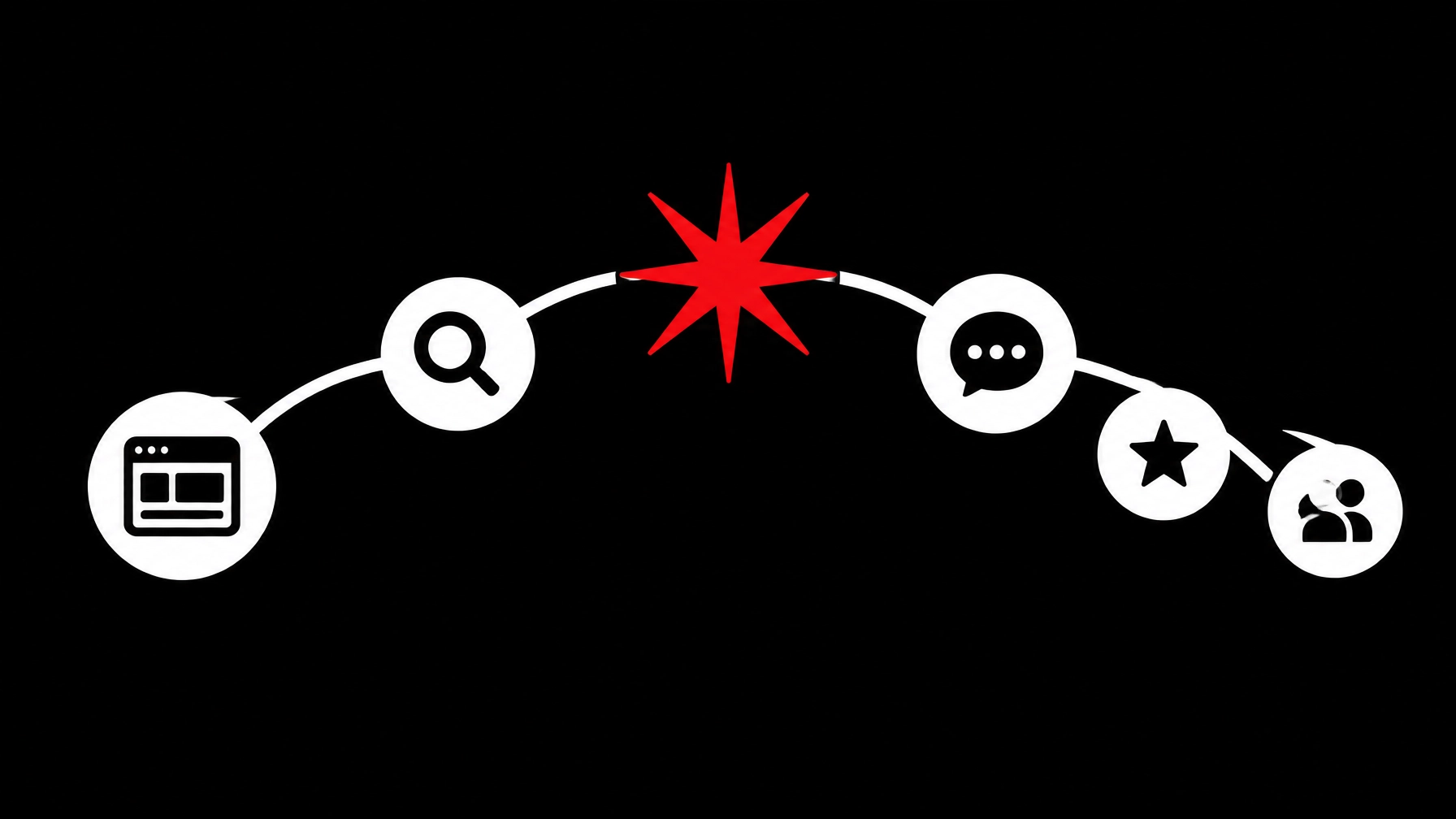
That usually includes a review of the major stages in the customer journey:
- Discovery: How do potential customers find you through search, social media, referrals, reviews, or AI-driven tools?
- Evaluation: Can they quickly understand what you offer, who it is for, and why your approach is relevant?
- Decision: Is it easy to contact you, request information, schedule a conversation, or buy?
- Onboarding: Does the first experience confirm the expectations created by your marketing?
- Delivery: Does the product, service, communication, and support reflect your stated position?
- Retention and advocacy: Do customers have a reason to return, renew, refer, or leave a positive review?
The goal is not to redesign every touchpoint at once. It is to identify the moments that most influence trust, conversion, retention, and referrals.
In many cases, the highest-impact improvements are practical: a clearer call to action, a more useful service page, a better handoff between marketing and sales, or a consistent response process.
Your integrated marketing system must tell one story
Your website, SEO, social media, content, reviews, email, and sales conversations are connected parts of one customer experience. Treating them as separate activities can create unnecessary friction.
Consider a potential customer searching for your service:
- SEO helps them discover you.
- The website helps them understand your offer.
- Content answers questions and demonstrates expertise.
- Social media adds context and familiarity.
- Reviews provide outside validation.
- The sales process confirms whether your organization is responsive and credible.
- The customer experience determines whether the promise was accurate.
If these elements use different language or emphasize conflicting benefits, customers must do the work of connecting the story themselves. That extra effort can lower conversion, even when traffic and engagement appear healthy.
A stronger strategic marketing plan sets shared priorities across the system. It identifies the message that should be repeated, the proof that supports it, the audience it is intended to reach, and the metrics that indicate whether the experience is working.

How to connect brand positioning to customer experience
A practical approach starts with four questions.
1. What promise are you making?
State your core value in plain language. Avoid broad claims such as “best-in-class” or “innovative” unless you can explain what those words mean in the customer’s experience.
A stronger promise identifies a meaningful outcome, for example, helping customers make faster decisions, reduce complexity, improve visibility, or move forward with greater confidence.
2. What evidence supports the promise?
Every important claim should have proof. Evidence may include:
- Customer testimonials
- Case studies
- Reviews
- Before-and-after metrics
- Certifications or relevant experience
- Clear process descriptions
- Demonstrations of your work
- Response-time or service commitments
If your positioning cannot be supported by visible proof, customers may treat it as advertising rather than a reason to trust you.
3. Where does the experience contradict the promise?
Review the customer journey from the outside. Look at your business as a first-time visitor would.
Check for:
- Conflicting messages between pages and platforms
- Broken or unclear conversion paths
- Long delays in communication
- Confusing pricing or service information
- Inconsistent visual and verbal identity
- Unanswered reviews or outdated listings
- Content that attracts the wrong audience
You do not need to solve every issue immediately. Rank each gap by its effect on customer trust, conversion, revenue, and retention.
4. Which metrics show whether the change worked?
Better decisions require more than activity metrics. Impressions, likes, and traffic can provide context, but they do not always show whether customers understand or trust your position.
Consider measuring:
- Website conversion rate
- Qualified inquiry rate
- Form completion rate
- Time to first response
- Sales conversion rate
- Customer retention or renewal rate
- Review volume and rating trends
- Referral activity
- Branded search growth
- AI visibility and accuracy
Set a baseline before making changes. Then review performance after 30, 60, and 90 days where the customer journey and buying cycle make that practical.
Where AI visibility fits into the customer experience
AI visibility is now part of modern marketing performance because customers increasingly use AI-powered tools to compare providers, summarize options, and identify recommendations.
Your business may be discussed by an AI system before a customer ever visits your website. That makes clarity especially important. If your website, directory profiles, reviews, and content describe your business inconsistently, AI tools may not understand your audience, services, location, or differentiators accurately.
A brand positioning strategy helps create the consistent foundation that AI systems can interpret. Customer experience consulting then tests whether that message is supported across the places customers look for confirmation.
Review:
- Whether your core services are clearly described
- Whether your ideal customers are identifiable
- Whether your expertise is supported by relevant content
- Whether your business information is consistent
- Whether customer reviews reinforce your intended position
- Whether your website answers common decision-stage questions
AI visibility is not a replacement for trust. It is another environment where trust signals and message clarity need to work together.
A quick self-assessment: what does your business need most?
Choose the statement that best describes your current situation:
A. “Our message is unclear.”
You may need brand positioning strategy, audience clarification, and a focused messaging framework.
B. “Our message is clear, but the experience is inconsistent.”
You may benefit from customer experience consulting, journey mapping, and touchpoint prioritization.
C. “Our marketing is active, but performance is difficult to explain.”
You may need a marketing audit, measurement review, and a strategic marketing plan tied to business outcomes.
D. “We know what needs to change, but our team needs help executing.”
You may need targeted implementation support after the priorities and direction are clear.
This exercise is intentionally simple. The purpose is not to label your business permanently. It is to help you identify where clarity is most needed before investing in more activity.

How to build a strategic marketing plan that holds up
A strategic marketing plan should reflect customer behavior, not just internal assumptions. To make it more durable:
- Start with customer reality. Review feedback, inquiries, reviews, sales conversations, and drop-off points.
- Clarify the position. Define the audience, problem, difference, and value you can credibly own.
- Map the high-impact journey. Identify the touchpoints that influence discovery, trust, conversion, and retention.
- Prioritize the largest gaps. Focus first on changes that improve clarity or remove friction.
- Assign ownership. Every priority should have a person, timeline, and success measure.
- Review and refine. Customer expectations, search behavior, and market conditions change. Your plan should learn from evidence.
This approach prevents a common mistake: increasing marketing spend before confirming that the customer journey can support the demand you are trying to create.
FAQ: Is brand positioning part of customer experience?
Yes. Brand positioning defines the promise customers should associate with your business. Customer experience is how they encounter and evaluate that promise across real interactions.
The two functions are different, but they are closely connected. Positioning without a supporting experience creates skepticism. Experience without clear positioning can become difficult to recognize or differentiate.
FAQ: When should you consider customer experience consulting?
Consider it when customers are visiting but not converting, when reviews and internal assumptions do not match, when teams communicate inconsistently, or when growth has created friction between marketing, sales, service, and operations.
It is also useful before a rebrand, website redesign, market expansion, or major investment in advertising. Clarity before spend helps you avoid scaling a process that is not ready.
FAQ: How does this work with an existing marketing team?
Customer experience consulting can complement an internal team by providing an independent view of the customer journey, messaging, channels, and priorities. The goal is not to replace your team. It is to help your team focus effort where it can create the greatest meaningful impact.
Make your promise easier to believe
Your customers do not experience your strategic marketing plan directly. They experience its consequences: in the messages they read, the answers they receive, the forms they complete, the service they receive, and the follow-up that comes afterward.
That is why brand positioning strategy and customer experience consulting belong in the same conversation. Your positioning gives the business direction. Your customer experience proves whether that direction is real.
Before you increase your marketing spend, take the time to understand where the promise is strong, where the proof is missing, and which customer touchpoints deserve attention first.
Explore Flint Avenue’s consulting services to identify the right next step for your business, whether you need focused guidance, a broader strategic review, or support turning a clear plan into action.