
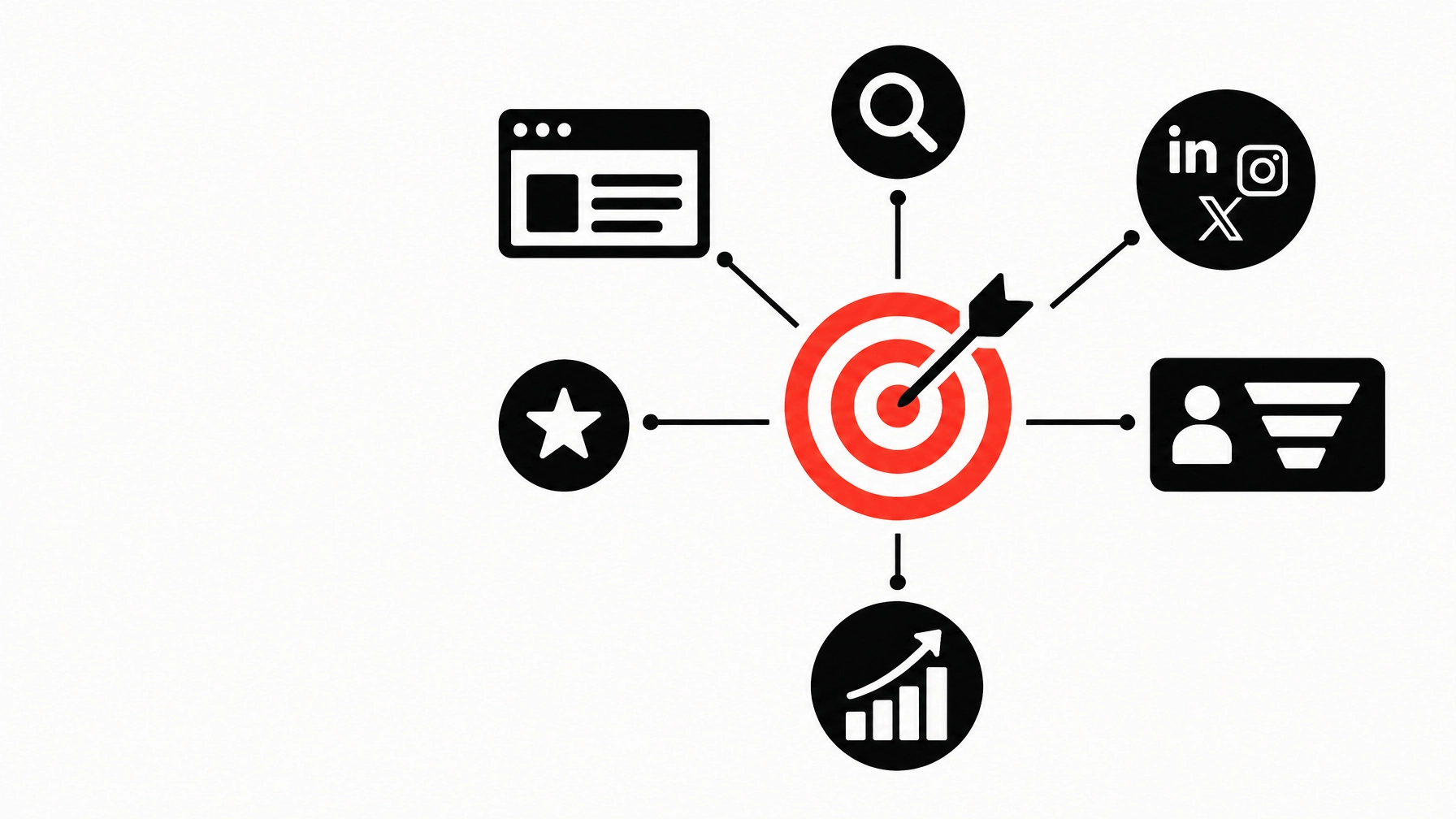
Suggested meta title: Marketing ROI Analysis: Tie Campaigns to Revenue
Suggested meta description: Learn how marketing ROI analysis connects campaign activity to revenue, profit, and smarter budget decisions, without drowning in dashboards.
Marketing has become more connected, and more difficult to evaluate. Your website, search visibility, social media, email, content, advertising, reviews, and customer experience all influence how people discover and choose your business.
The challenge is not a lack of data. It is knowing which data should guide a decision.
A campaign can generate thousands of impressions, a strong click-through rate, or hundreds of leads and still fail to create meaningful business impact. That is why marketing ROI analysis matters. It helps you move beyond activity reporting and understand whether your investment is creating revenue, profit, qualified pipeline, customer retention, or another clearly defined outcome.
The goal is not to measure everything. The goal is to make better decisions with the right measures.

What Is Marketing ROI Analysis?
Marketing ROI analysis evaluates the financial return generated by a marketing investment.
The basic formula is:
Marketing ROI = (Marketing-attributed revenue − Marketing cost) ÷ Marketing cost × 100
For example, if a campaign generates $100,000 in attributed revenue and costs $25,000 to run:
($100,000 − $25,000) ÷ $25,000 = 300% ROI
That calculation is useful, but only when the inputs are reliable.
Your total marketing cost should include more than advertising spend. Consider including:
- Media and sponsorship costs
- Creative production
- Agency or consulting fees
- Marketing software
- Internal team time
- Landing page or website development
- Sales support associated with the campaign
When possible, evaluate ROI using gross profit rather than revenue. A campaign that produces $100,000 in sales may not be as valuable as it appears if margins are low or fulfillment costs are high.
Oracle’s marketing ROI overview also distinguishes between revenue, acquisition cost, sales cycle length, engagement, and customer lifetime value. Each metric answers a different question, so you should not treat them as interchangeable.
Start With the Business Outcome
Before choosing a platform, audience, or creative concept, define what the campaign is expected to accomplish.
A clear outcome might be:
- Generate $50,000 in qualified pipeline
- Acquire 40 new customers
- Increase repeat purchases by 10%
- Reduce customer acquisition cost by 15%
- Generate 100 qualified consultations
- Increase applications, enrollments, or event registrations by 20%
Then select supporting metrics that help you understand progress toward that outcome.
For example:
| Business outcome | Supporting metrics |
|---|---|
| Generate qualified pipeline | Qualified leads, conversion rate, cost per qualified lead |
| Acquire new customers | Customer acquisition cost, close rate, revenue per customer |
| Increase retention | Repeat purchase rate, renewal rate, customer lifetime value |
| Improve visibility | Branded search, direct traffic, review volume, AI visibility |
| Increase conversions | Website conversion rate, landing page completion, form abandonment |
This distinction is important. Impressions, clicks, and engagement are not useless, but they are usually diagnostic metrics, not final business outcomes.
They tell you what may be happening. They do not necessarily tell you what deserves more budget.
What to Measure, and What to Ignore
A practical marketing ROI analysis usually includes three levels of measurement.
Tier 1: Activity metrics
These show whether marketing activity is occurring.
- Impressions
- Reach
- Website sessions
- Email sends
- Social media posts
- Content published
- Ad clicks
Activity metrics can help identify delivery problems. If an ad is not reaching the intended audience, or an email is not being delivered, you need to know.
However, activity alone should not justify continued investment.
Tier 2: Efficiency metrics
These show how effectively your activity is producing a response.
- Click-through rate
- Conversion rate
- Cost per lead
- Cost per qualified lead
- Cost per acquisition
- Engagement rate
- Landing page conversion rate
Efficiency metrics help you optimize campaigns. They can show whether one audience, message, offer, or channel is outperforming another.
Still, an inexpensive lead is not automatically a valuable lead.
Tier 3: Business outcome metrics
These connect marketing activity to organizational performance.
- Revenue
- Gross profit
- Qualified pipeline
- New customers
- Customer lifetime value
- Retention
- Incremental revenue
- Marketing ROI
- Return on ad spend
This is where budget decisions should happen.
If your reporting stops at clicks or leads, you may be optimizing marketing activity without improving business performance.
Build the Connection From Spend to Revenue
A campaign should have a traceable path from investment to outcome:
Spend → Response → Qualified opportunity → Customer → Revenue or profit
Suppose your campaign costs $30,000, including advertising, content production, and internal time.
It produces:
- 600 qualified leads
- A $50 cost per qualified lead
- A 15% lead-to-customer rate
- 90 new customers
- $1,200 in average revenue per customer
- $108,000 in total revenue
- A 60% gross margin
The campaign generated $64,800 in gross profit.
That creates two different views:
- Revenue-based ROI: 260%
- Profit-based ROI: 116%
Both calculations are valid, but profit-based ROI gives leadership a more realistic view of financial impact.
Your CRM, website analytics, advertising platforms, email system, and billing or ecommerce tools should work together as much as practical. Use consistent campaign names and tracking parameters so you can identify:
- Where a lead originated
- Which content influenced the decision
- When a lead became an opportunity
- Which campaign was associated with the sale
- How much revenue or profit followed
A clean campaign taxonomy is often more valuable than another dashboard.
Do Not Let Attribution Create False Confidence
Attribution assigns credit for a conversion to one or more marketing touchpoints.
A last-touch model may credit the final email or ad someone interacted with before purchasing. A multi-touch model may distribute credit across the website, content, social media, search, and sales interactions that influenced the customer journey.
Neither approach is perfect.
A customer may see your social post, read three articles, search for your business, review your customer testimonials, visit your website, and speak with your team before becoming a customer. Which touchpoint created the sale?
The answer is usually not one channel acting alone.
Use attribution to understand the customer journey, but do not assume attributed revenue is the same as incremental revenue. Incrementality asks a more useful question:
How many conversions would not have happened without this marketing investment?
Where possible, use experiments such as:
- Geographic holdout tests
- Audience split tests
- Landing page experiments
- Promotional control groups
- Before-and-after comparisons with appropriate context
For broader budget decisions, compare campaign results across multiple time periods and customer cohorts. A single month of performance can be misleading.
Harvard Business Review’s refresher on marketing ROI highlights why connecting marketing investment to financial results can be difficult, especially when customers interact with multiple channels over an extended period.
Include Website, SEO, Reviews, and AI Visibility
Marketing ROI analysis should not isolate paid advertising from the rest of your customer experience.
A campaign may send qualified visitors to your website, but unclear messaging can prevent them from converting. Strong SEO may increase discovery, but poor reviews can reduce trust. Social media may create awareness, while an inconsistent website makes the business appear less credible.
These elements work together.
Your measurement framework should consider:
- Website conversion rates
- Organic search visibility
- Branded search activity
- Content-assisted conversions
- Social referral traffic
- Review volume and sentiment
- Direct traffic
- Email engagement
- AI visibility and how accurately your organization appears in AI-generated answers
AI visibility is now part of modern marketing performance. If potential customers use AI-powered search or answer tools to evaluate your business, your messaging, services, expertise, and trust signals need to be clear and consistent across the digital environment.
This does not mean chasing every new platform. It means evaluating whether your business is understandable, discoverable, and credible wherever customers look for answers.
A Simple Budget Decision Framework
Use this three-part framework during monthly or quarterly performance reviews.

1. Invest
Increase support for campaigns that show:
- Consistent business outcomes
- Acceptable or improving acquisition costs
- Strong customer quality
- Sustainable profit or pipeline contribution
- Clear alignment with business priorities
2. Improve
Do not immediately cut campaigns that show potential but have a clear weakness.
Improve them when:
- The message is unclear
- The landing page underperforms
- Leads are not being qualified properly
- Sales follow-up is inconsistent
- Tracking is incomplete
- The offer does not match the audience
Sometimes the issue is not the channel. It is the customer experience surrounding the channel.
3. Pause
Pause or reduce investment when:
- The campaign cannot be connected to a meaningful outcome
- Results remain weak after reasonable optimization
- Lead quality is consistently poor
- Costs exceed the value of acquired customers
- The campaign no longer supports a strategic priority
Pausing is not failure. It is a responsible use of budget when the evidence shows that another investment deserves priority.
Which Marketing Performance Consulting Tier Fits You?
Your next step depends on your current level of clarity.
Tier 1: You need focused guidance.
You are a business owner or small team with specific questions about budget, channels, reporting, or campaign performance. A focused consulting session can help you identify the highest-priority issue.
Tier 2: You need a comprehensive evaluation.
Your organization has multiple channels, inconsistent reporting, or uncertainty about what is working. A structured audit can connect marketing, sales, technology, customer experience, and business outcomes.
Tier 3: You need strategy and implementation support.
You have a time-sensitive campaign or growth priority and need a clear strategy, tracking structure, messaging, and launch support.
Flint Avenue’s consulting packages are designed around these different levels of need, from focused advice to deeper strategy and execution support.
Frequently Asked Questions
What is the most important marketing ROI metric?
There is no single metric for every business. Revenue, gross profit, customer acquisition cost, qualified pipeline, retention, and customer lifetime value can all be important. The right metric depends on your campaign objective and business model.
Is ROAS the same as marketing ROI?
No. Return on ad spend measures revenue generated against advertising spend. Marketing ROI should account for the broader cost of the campaign, including labor, creative, software, consulting, and other expenses.
How often should you review marketing ROI?
Review activity and efficiency metrics monthly, especially during active campaigns. Review revenue, profit, customer quality, and budget allocation quarterly or according to your sales cycle.
What if your tracking is incomplete?
Start with the most important conversion path. Document campaign names, use consistent tracking links, connect lead sources to your CRM, and establish a baseline. Better decisions are possible even before measurement is perfect.
Make Your Next Budget Decision With More Confidence
Marketing ROI analysis is not about creating a larger dashboard. It is about creating a clearer connection between what you spend, what customers experience, and what your organization earns.
Start by selecting one campaign. Define its business outcome. Include the full cost. Trace the path from response to revenue. Then decide whether the campaign deserves more investment, targeted improvement, or a pause.
If your reporting is fragmented, or if you need an independent perspective on what is truly driving performance, talk with Flint Avenue about marketing performance consulting. We help organizations evaluate marketing effectiveness, improve visibility, prioritize opportunities, and make smarter budget decisions with greater confidence.