
Suggested meta title: AI Visibility and SEO in 2026 | Flint Avenue
Suggested meta description: Learn how SEO, AEO, and GEO work together in 2026-and how accurate business information turns AI visibility into qualified leads.
Customers are changing how they discover businesses. They still use Google, maps, websites, and social platforms, but they are also asking AI assistants to compare options, explain services, and recommend who to contact.
That shift changes what visibility means.
A business can rank well for a keyword and still be absent from the answer a customer trusts. It can receive website traffic without being clearly understood. It can appear in search results while inconsistent hours, outdated services, or mixed messaging create doubt at the moment a buyer is ready to act.
In 2026, your marketing has to do more than attract attention. It has to make your business easy to find, understand, verify, and choose.
That is the foundation of an effective AI marketing strategy.
AI assistants are becoming part of the customer journey
Traditional search generally gave customers a list of links. The customer clicked, compared pages, and made a decision.
AI assistants and answer engines increasingly summarize that process. A customer might ask:
- “Who provides marketing consulting for a growing business without a full marketing team?”
- “What should I look for in a marketing performance consulting firm?”
- “Which local roofing companies have strong reviews and residential experience?”
- “What are the best options for a company that needs strategy before execution?”
The answer may name only a few businesses. It may describe their services, compare their strengths, and suggest which option fits the customer’s needs.
This means your business can influence a decision before a prospect ever visits your website.
Recent research from WordPress VIP’s Future of the Web 2026 report illustrates the importance of this shift. The report found that 74% of enterprise decision-makers consider AI discoverability and attribution a main or significant priority. It also found that 86% of consumers always or sometimes check the original source after receiving an AI summary.
The answer gets you noticed. Your website and reputation determine whether the customer trusts what they find next.
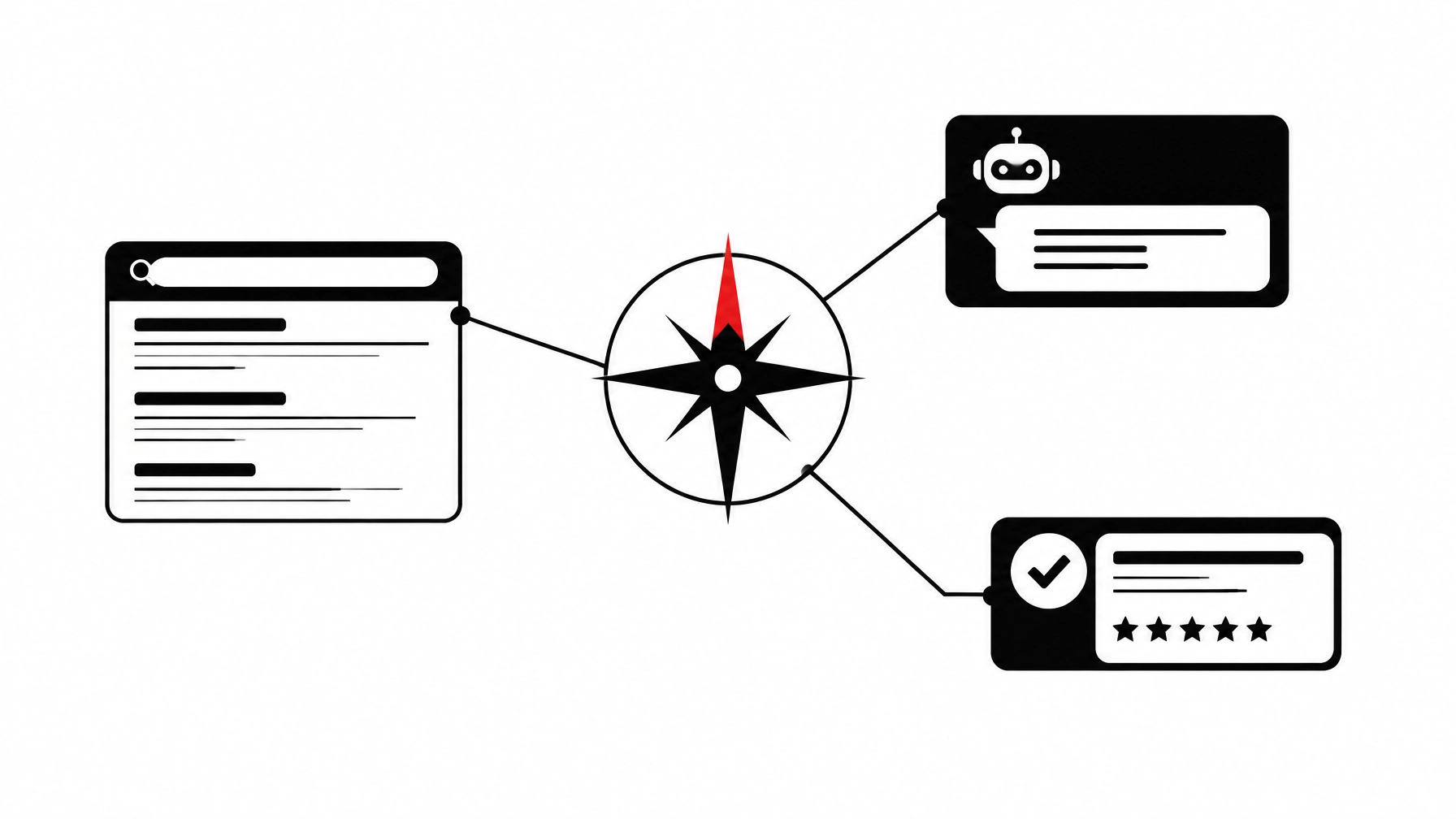
SEO, AEO, and GEO work together
You do not need three disconnected strategies. You need one integrated visibility plan that supports three related functions.
SEO helps systems find and understand you
Search engine optimization still matters. Your website must be accessible, crawlable, useful, and technically clear.
That includes:
- Clear service pages
- Logical website navigation
- Helpful, original content
- Accurate local information
- Fast and mobile-friendly pages
- Structured data where appropriate
- Relevant links from credible sources
If search engines and AI systems cannot access or understand your website, they have fewer reliable facts to use in an answer.
AEO makes your information easier to extract
Answer Engine Optimization focuses on how clearly your content responds to questions.
AEO may include:
- Direct answers near the beginning of a section
- Clear headings and concise paragraphs
- Frequently asked questions
- Defined services, locations, audiences, and processes
- Comparison content that explains who your service is best for
- Case studies that show outcomes and context
A page should not force a customer, or an AI system, to hunt for the answer. If your business serves small businesses, mid-sized organizations, or specific industries, say so plainly. If your process begins with an audit, explain what the audit evaluates and what the customer receives.
GEO supports recommendations and trust
Generative Engine Optimization focuses on how your business appears in AI-generated answers and recommendations.
GEO is not about inserting a phrase repeatedly or trying to manipulate a chatbot. It is about building a consistent, credible body of information across your website and the wider web.
AI systems may look at your:
- Website
- Google Business Profile
- Industry directories
- Review platforms
- Social profiles
- News coverage
- Partner websites
- Case studies and testimonials
SEO helps you get retrieved. AEO helps your information get summarized. GEO helps your business become a credible option in the final answer.

Rankings alone no longer tell the whole story
Rankings are still useful, but they are not a complete measurement of modern marketing performance.
A traditional report may show that a page ranks number three for a target keyword. That is helpful, but it does not answer several important questions:
- Is the business mentioned in AI-generated answers?
- Is the business described accurately?
- Is it recommended for the right customer need?
- Are prospects visiting the correct service page?
- Are AI-referred visitors submitting forms or making calls?
- Are those leads qualified?
- Does visibility create revenue, bookings, or meaningful conversations?
AI search can influence a customer without producing an immediate click. A prospect may see your business named in an answer, remember it, and visit your website later through direct traffic. Another prospect may click through but leave because the page does not clearly confirm the service, location, or next step.
That is why visibility should be measured alongside trust and business outcomes.
Useful metrics include:
- AI mentions and citations
- AI referral traffic
- Organic traffic to priority service pages
- Calls and form submissions
- Conversion rate by source
- Qualified lead rate
- Booked consultations
- Sales opportunities influenced by marketing
- Revenue or customer value tied to those opportunities
This is the difference between collecting more data and making better decisions.
Accuracy and consistency create confidence
AI visibility depends partly on whether systems can confidently identify and verify your business.
Your core information should align across your website, reviews, directories, maps, and social profiles. That includes:
- Business name
- Address and service area
- Phone number
- Hours of operation
- Primary services
- Industry or business category
- Team expertise
- Pricing information, when appropriate
- Customer experience and differentiators
Inconsistent information creates friction. If your website says you serve one area but a directory lists another, or if your social profile describes services your website does not mention, customers may hesitate, and AI systems may represent you incorrectly.
Reviews add another layer of evidence. Genuine reviews help communicate what customers value, how you work, and which outcomes you deliver. Responding thoughtfully to reviews also shows that your business is active and attentive.
The goal is not to manufacture praise. It is to make real customer experience visible and easy to understand.
Your website should also support the story found elsewhere. Include relevant testimonials, case studies, service details, and clear explanations of who your business helps. As Moz explains in its 2026 guidance on AI visibility, strong AI visibility is connected to accessibility, usefulness, consistency, credibility, corroboration, and differentiation.

A simple three-tier starting plan
Not every business needs the same level of investment. Start with the tier that matches your current opportunity.
Tier 1: Basic clarity
Choose this tier if your business information is outdated, inconsistent, or difficult to explain.
Focus on:
- Reviewing your website’s primary service pages
- Clarifying your audience and value proposition
- Correcting business listings and profile information
- Updating hours, services, and contact details
- Identifying the three questions customers ask most often
- Creating clear answers on your website
Your starting question: Can a new customer understand who you help, what you do, and how to contact you in less than two minutes?
Tier 2: Better discoverability
Choose this tier if your foundation is solid but you are not appearing consistently across search and answer experiences.
Focus on:
- Improving technical SEO
- Building or updating location and service pages
- Creating FAQ and comparison content
- Adding relevant structured data
- Strengthening reviews and testimonials
- Aligning messaging across social profiles and directories
- Reviewing how AI assistants describe your business
Your starting question: When customers ask questions related to your services, are you present, and represented accurately?
Tier 3: Strategic growth
Choose this tier if you need visibility tied directly to growth goals, sales opportunities, or investment decisions.
Focus on:
- Grouping AI and search prompts by customer intent
- Tracking mentions, citations, referrals, and conversions
- Connecting marketing data to your CRM
- Defining qualified lead criteria with sales
- Auditing customer journeys across website, content, and follow-up
- Prioritizing channels based on business impact
- Reviewing performance on a regular schedule
Your starting question: Which visibility improvements are producing qualified opportunities, and which activities should be reduced or stopped?
If you are unsure which tier fits, ask yourself one simple question: Do you need clearer information, stronger discoverability, or a strategic growth plan?
How to connect visibility to qualified leads
An increase in AI mentions is encouraging, but it is not the final goal. The final goal is meaningful business impact.
Start by selecting a small group of priority services and customer questions. Then establish a baseline:
- Record current rankings, AI mentions, website traffic, calls, and form fills.
- Identify which sources produce qualified leads, not just inquiries.
- Add tracking to important campaigns and links.
- Ask new prospects how they found you.
- Review lead quality and sales outcomes monthly.
- Update content and listings based on what you learn.
For example, if AI visibility increases but qualified leads do not, the issue may be message clarity, page experience, offer fit, or follow-up, not visibility alone.
This is where marketing performance consulting can help. A clear review looks across the full system (website, SEO, content, social media, reviews, directories, analytics, and customer experience) to identify what deserves attention first.

Frequently asked questions
Is SEO still important in 2026?
Yes. SEO remains the foundation that helps search engines and AI systems find, access, and understand your content. AI visibility expands the search journey; it does not replace the fundamentals.
What is the difference between AEO and GEO?
AEO focuses on making content easy to extract as a direct answer. GEO focuses on how your business is represented and recommended in generative AI experiences. Both work alongside traditional SEO.
Do I need to publish more content to improve AI visibility?
Not necessarily. First, evaluate whether your current content is accurate, useful, clearly structured, and differentiated. Improving existing pages may create more value than publishing several new articles.
How often should I review AI visibility?
A practical starting point is quarterly. Businesses in fast-changing industries or active growth stages may benefit from monthly reviews of priority prompts, business information, referrals, and lead quality.
Can a small business compete in AI search?
Yes. Smaller businesses can improve visibility by being specific and consistent. Clear service descriptions, credible reviews, useful local content, accurate listings, and a distinct customer promise can provide stronger signals than a broad, generic website.
Your practical next step
Before increasing your marketing spend, choose one priority service and audit how it appears across your website, Google Business Profile, directories, reviews, and social profiles.
Ask:
- Is the information accurate?
- Is the message consistent?
- Can a customer understand the value quickly?
- Does the page answer real buying questions?
- Can you measure whether visibility leads to qualified conversations?
If the answers are unclear, you do not necessarily need more marketing activity. You need a clearer view of what is working, where trust is breaking down, and which improvement should come first.
Talk with Flint Avenue about your visibility and marketing strategy. We can help you evaluate the full customer discovery journey, prioritize the highest-impact opportunities, and build a practical plan for stronger visibility and better business decisions.