
Search is changing from a list of links into a conversation. Customers still use Google, but they are also asking ChatGPT, Gemini, Perplexity, Google AI Overviews, and other AI tools questions such as:
- “What is the best accounting firm for a growing construction company?”
- “Who provides reliable marketing consulting for small businesses?”
- “What should I look for in a local roofing contractor?”
- “Which agencies can help me improve my online visibility?”
Increasingly, those customers see a recommendation before they ever click a website.
That creates a new opportunity for small businesses: becoming visible, understandable, and credible in AI-generated answers. This is the foundation of AI visibility : and it is becoming a necessary part of a modern AI marketing strategy.
What Is AI Visibility?
AI visibility is the frequency and accuracy with which your business appears in AI-generated answers, recommendations, comparisons, and summaries.
It includes more than whether an AI tool mentions your company name. Strong AI visibility means the tool can accurately understand:
- What your business does
- Who you serve
- Where you operate
- What makes you different
- Which problems you solve
- Whether customers trust your business
- How your services compare with other options
A business may have a beautiful website and a strong social media presence but still be difficult for AI systems to recommend if its message is inconsistent or its most important information is unclear.
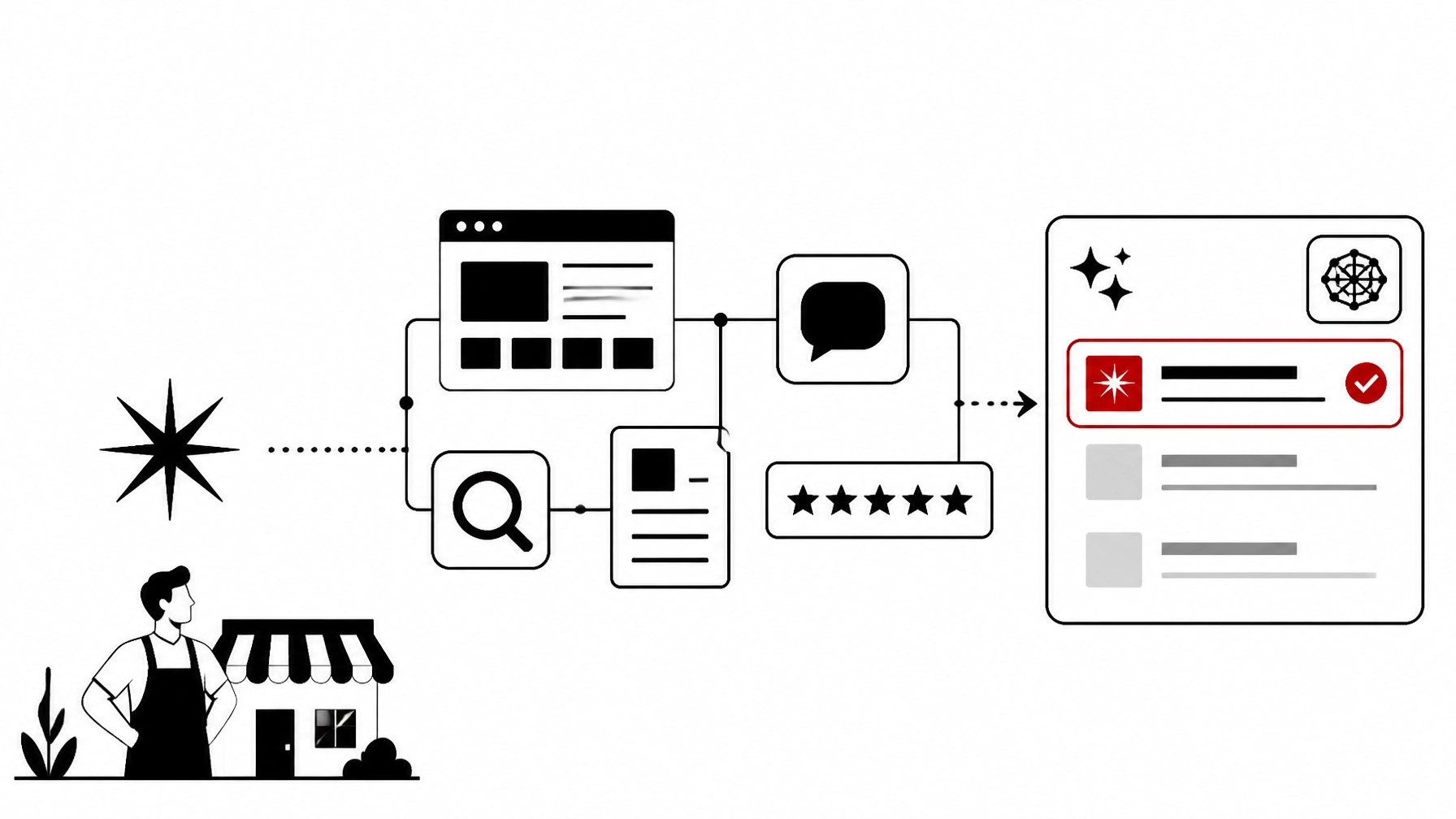
AI systems need evidence. They look across websites, search results, business profiles, reviews, directories, news coverage, and other trusted sources to form an answer.
Your goal is not to manipulate an algorithm. Your goal is to make your business easier to understand : for both AI systems and the people who make buying decisions.
AEO, GEO, and GXO: What Do These Terms Mean?
The terminology around AI search is still developing, but three terms appear frequently:
- AEO : Answer Engine Optimization: Structuring content so search engines and AI tools can extract clear answers.
- GEO : Generative Engine Optimization: Improving how your brand appears in generative search and large language model responses.
- GXO : Generative Experience Optimization: Managing the broader experience created when AI summarizes, compares, or recommends your business.
These terms describe related activities. For a small business, the practical work is straightforward:
- Explain your business clearly.
- Publish useful, answer-focused content.
- Keep information consistent across the web.
- Build visible trust through reviews and third-party mentions.
- Measure how AI tools describe and recommend you.
You do not need a separate strategy for every new acronym. You need an integrated marketing system that gives customers and AI tools the same clear story.
Why AI Visibility Depends on Your Entire Marketing System
AI visibility does not exist separately from SEO, content, social media, reviews, or your website. It is connected to all of them.
Think of your marketing as a system with five primary signals.
1. Your Website
Your website is usually the most important source of information about your business. It should clearly communicate:
- Your primary services
- Your target customers
- Your geographic area or service region
- Your process
- Your experience
- Your results
- Your differentiators
- How a prospective customer can take the next step
Avoid relying on vague phrases such as “innovative solutions” or “full-service excellence.” Those statements may sound polished, but they do not explain what you actually do.
A clear service page might state exactly who the service is for, what challenge it addresses, what the engagement includes, and what outcome the customer can reasonably expect.
2. Search Engine Optimization
Google’s official guidance on AI features explains that pages must meet the same basic requirements as other search results to be eligible as supporting links in AI Overviews and AI Mode. There are no secret technical requirements that guarantee inclusion.
The fundamentals still matter:
- Allow search engines to crawl your pages.
- Make important information available as text.
- Use internal links to connect related content.
- Maintain a strong mobile experience.
- Keep your business profile information current.
- Use structured data that matches the visible content on the page.
Traditional SEO remains part of AI visibility because AI search systems still need reliable, discoverable information to retrieve and reference.
3. Helpful Content
AI systems are more likely to use content that directly addresses real questions. That means your content strategy should move beyond announcements and promotional posts.
Create resources that answer questions such as:
- How much does this type of service typically involve?
- What should a customer evaluate before hiring a provider?
- What are the most common mistakes in this process?
- Which option is best for a small business?
- What changes when a company enters a new market?
- How can leadership teams measure marketing performance?
This is where a strategic marketing plan becomes valuable. Instead of publishing content because the calendar says it is time to post, you connect each topic to a customer question, a business priority, and a measurable next step.
4. Reviews and Third-Party Trust
Reviews help people make decisions : and they also provide outside evidence about your business.
Encourage customers to describe specific experiences rather than only giving a star rating. A useful review might explain:
- What problem the customer faced
- Why they chose your business
- What the engagement included
- How the experience improved their situation
- What result or meaningful impact followed
Keep your business name, services, location, and contact information consistent across your website, Google Business Profile, directories, professional associations, and social platforms.
The Schema.org LocalBusiness vocabulary includes properties such as name, description, address, service area, reviews, and URL. Structured data can help machines interpret your business : but it should always reflect information that is visible and accurate.
5. Brand and Customer Experience
AI may recommend your business, but a human still decides whether to trust you.
That is why brand positioning strategy remains central to AI marketing strategy. Your positioning should answer one important question:
Why should this customer choose you instead of another credible option?
If your website says you serve everyone, offers every service, and promises every outcome, AI may struggle to identify where you are the best fit. Clear positioning gives both algorithms and customers a reason to remember you.

Start With an AI Visibility Audit
Before investing in more content, advertising, or technology, establish a baseline.
Create a list of 10–15 questions that reflect how your customers actually search. Include questions related to:
- Your most profitable service
- Your primary customer segment
- Your location or service area
- Your major competitors
- The problem your business solves
- The category you want to own
Run those questions through the AI platforms your customers use. Test each prompt at least three times because answers can vary.
Track:
- Whether your business is mentioned
- Whether your website is cited
- Which competitors appear
- How your business is described
- Whether the description is accurate
- Whether the tone is positive, neutral, or negative
- What information appears to be missing
This simple process turns AI visibility from a vague concern into a measurable marketing performance issue.
If an AI tool cannot explain what you do, who you serve, or why customers trust you, the answer may not be “publish more content.” You may need to clarify your positioning, restructure your website, improve your reviews, or correct inconsistent business information.
That is the purpose of effective marketing audit services: identifying what is working, what is unclear, and what deserves attention first.
Three Levels of AI Visibility Readiness
Level 1: Foundational Clarity
You are at this level if:
- Your website has outdated or incomplete service information.
- Different platforms describe your business differently.
- Your homepage does not clearly state who you serve.
- Your reviews are limited or too general.
- You have not checked how AI tools describe your company.
Your priority is to create a clear business foundation before adding more campaigns.
Level 2: Organized Visibility
You are at this level if:
- Your core services and audiences are clearly defined.
- Your website has useful service pages and educational content.
- Your business profiles are consistent.
- You collect customer reviews regularly.
- You can track search traffic, leads, and conversions.
Your priority is to connect the system : linking content to service pages, reviews to customer concerns, and marketing activity to business outcomes.
Level 3: Measured AI Performance
You are at this level if:
- You track AI mentions and citations over time.
- You monitor competitor visibility for the same prompts.
- You update content based on real customer questions.
- You measure qualified leads from organic and referral sources.
- Leadership uses marketing data to prioritize investment.
Your priority is continuous improvement. AI visibility should be treated as part of marketing performance, not as a one-time optimization project.
A Practical 90-Day AI Visibility Plan
Days 1–30: Establish the Baseline
Select 10–15 revenue-related prompts and test them across three AI platforms. Record mentions, citations, competitors, inaccuracies, and missing information.
At the same time, review your website analytics, search performance, review profiles, and conversion paths.
Days 31–60: Improve Clarity
Update your homepage, service pages, about page, and business profiles. Make your audience, service area, process, and differentiators explicit.
Add relevant internal links and confirm that structured data matches the visible page content. Do not add markup simply because it sounds technical : use it to accurately describe information already present.
Days 61–90: Publish and Measure
Create three to five answer-focused resources based on your highest-priority customer questions. These could include a guide, comparison, case study, FAQ, or decision checklist.
Then repeat your original prompt set. Compare:
- AI mention rate
- Citation rate
- Accuracy of your description
- Competitor appearance
- Organic impressions
- Website engagement
- Qualified inquiries
- Conversion rate
Visibility is not the final goal. Better visibility should support better customer decisions and stronger business results.

Does Your Business Need More Marketing : or More Clarity?
Choose the statement that best describes your current situation:
A. We are not sure which marketing activities are producing meaningful results.
B. We know what is working, but our website and message do not clearly explain our value.
C. Our marketing is organized, but we are not appearing consistently in AI-generated recommendations.
D. We need a focused growth direction, stronger positioning, or support entering a new market.
If you chose A, a marketing performance consulting engagement or audit may help identify priorities.
If you chose B, brand positioning and customer experience improvements may create more value than additional ad spend.
If you chose C, an AI visibility review can show how your business appears across modern search environments.
If you chose D, go-to-market strategy consulting can help connect audience, message, channels, budget, and measurable outcomes.
AI Visibility Is a Business Clarity Opportunity
Small businesses do not need to compete with the largest companies on every keyword or publish content every day. They need to become the clearest, most credible answer for the customers they are best equipped to serve.
That starts with marketing clarity before more marketing spend.
Your website should explain your value. Your content should answer real questions. Your reviews should reinforce trust. Your search strategy should make information easy to find. Your AI marketing strategy should connect each of these signals into one consistent experience.
Flint Avenue helps organizations evaluate visibility, strengthen messaging, and make more confident marketing decisions through audit-driven insights and strategic guidance. Book a discovery meeting to identify where your business is visible, where it is being overlooked, and what to prioritize next.

Frequently Asked Questions
What is AI visibility?
AI visibility is how often and how accurately your business appears in AI-generated answers, recommendations, comparisons, and summaries across tools such as ChatGPT, Gemini, Perplexity, and Google AI features.
Is AI visibility different from SEO?
AI visibility overlaps with SEO but extends beyond traditional rankings. It also considers how clearly AI systems understand your business, whether they cite your content, and how they describe your credibility and services.
Do I need special technical tools to appear in AI search?
No single tool or markup guarantees inclusion. Google states that the foundational requirements for appearing in AI Overviews and AI Mode are the same as standard search eligibility. Clear content, crawlable pages, accurate business information, and helpful user experiences remain important.
How should a small business measure AI visibility?
Start with a consistent set of 10–15 customer-focused prompts. Track mentions, citations, accuracy, sentiment, competitor appearances, qualified website traffic, inquiries, and conversions over time.
Can Flint Avenue help with AI visibility?
Yes. Flint Avenue provides visibility audits, AI discoverability analysis, messaging evaluation, competitor visibility analysis, strategic marketing direction, and targeted support to help organizations improve how they are understood by both AI systems and human customers.