
Meta title: Marketing Strategy for Small Business: A Clear Quarterly Rhythm
Meta description: Recap five practical marketing moves and build a repeatable quarterly rhythm to focus your budget, measure results, and improve AI visibility.
Marketing can feel like a list that keeps growing: another post, another platform, another report, another meeting about the report. But doing more doesn’t automatically mean your business is moving forward.
A smarter marketing strategy for small business starts with a different question: What is working, and what should you do next?
In our five-part Marketing Clarity & Strategic Performance series, we walked through a practical answer. Here’s the recap, assembled into a playbook you can repeat each quarter. No elaborate dashboard required. A clear priority, a few useful numbers, and the willingness to make a decision will get you started.
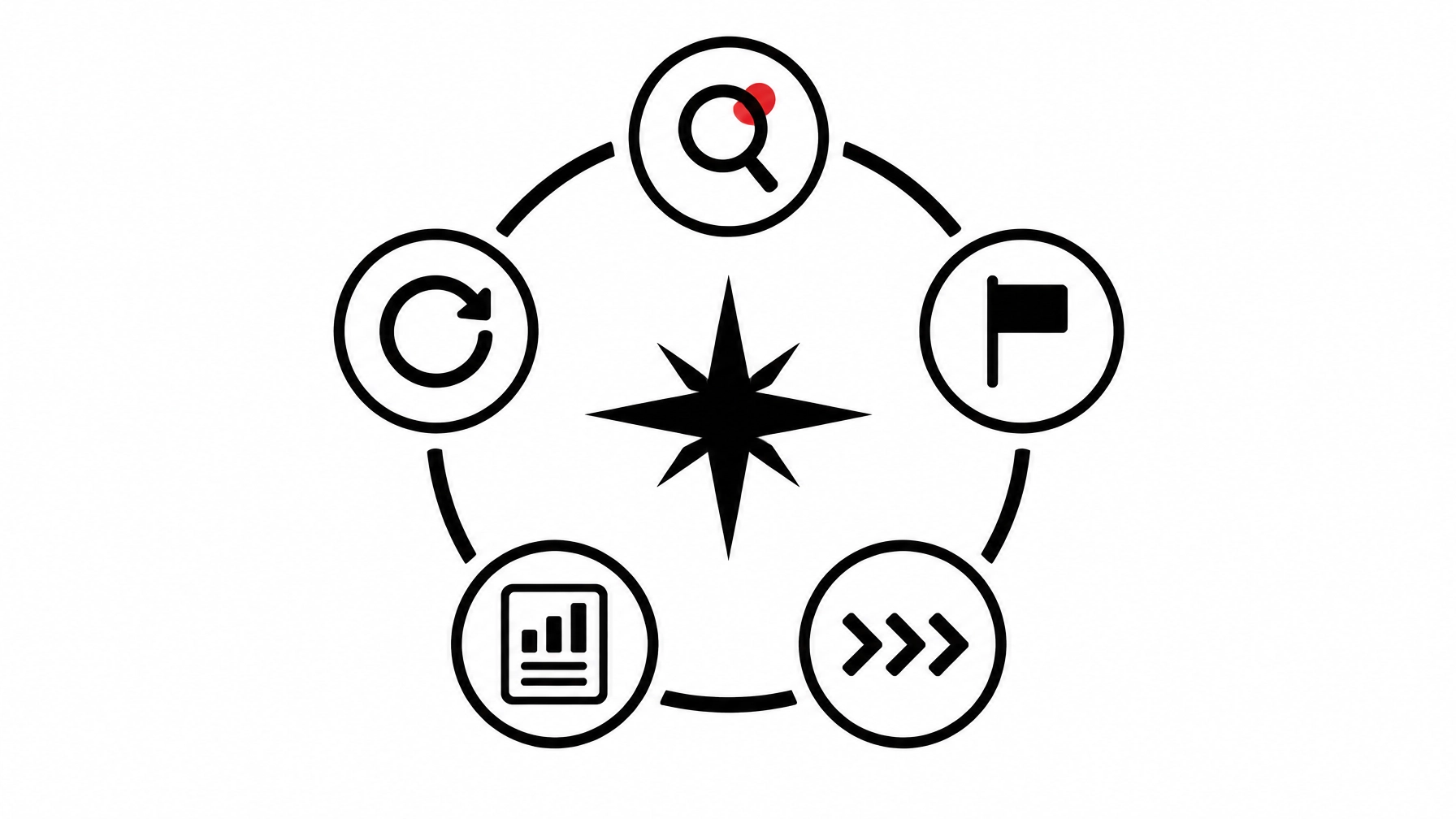
The five moves at a glance
- Review where your marketing money went.
- Choose the next investment by expected return, not habit.
- Turn one priority into a focused 90-day plan.
- Track a small scorecard that helps you decide.
- Review, adjust, and repeat before momentum drifts.
Let’s put each move to work.
Move 1: Give your marketing a 60-minute clarity reset
Before planning what to spend, look at what you already spent. Pull together the last three months of marketing costs, including ads, software, agency or freelancer support, events, and other major activities. Then ask: What did each investment help produce?
The goal isn’t to reconstruct every click or locate the one campaign responsible for every sale. It’s to spot obvious drift. Perhaps you’re paying for a tool nobody uses, maintaining a channel that hasn’t produced a qualified inquiry, or sending website visitors to a page that doesn’t explain what to do next.
Use three simple buckets:
- Keep: There’s a clear reason this is working or worth continuing.
- Improve: It has potential, but something is getting in the way.
- Question: You can’t explain the value, or the evidence is too thin.
Then choose one priority for the coming quarter. Not seven priorities wearing matching outfits. One.

Move 2: Decide where the next dollar has the best chance
Your next marketing dollar shouldn’t go to a channel simply because it’s familiar, fashionable, or already in the budget. Compare options by expected return and fit with your current goal.
If your priority is more qualified sales conversations, for example, ask whether improving your service page, strengthening local search visibility, testing paid search, or following up with past leads is most likely to help. The right answer depends on your business, your customers, and what your results show, not on a universal channel ranking.
A useful starting metric is ROMI, or return on marketing investment:
ROMI = (revenue attributed to marketing − marketing cost) ÷ marketing cost
For example, if you spend $2,000 and attribute $10,000 in revenue to that marketing, the calculation is ($10,000 − $2,000) ÷ $2,000 = 4, or 400%.
Treat that as a decision aid, not a magic truth machine. Attribution can be incomplete. Customers may see a social post, read reviews, visit your site later, and then call. Be consistent about which costs and revenue you include, and don’t confuse attributed revenue with proof that marketing caused every sale. The point is to make a more informed comparison than “we’ve always done it this way.”
Move 3: Turn one priority into a 90-day plan
A priority becomes useful when it tells you what to do this month. Keep the plan compact:
One priority. Three moves. One measurable outcome.
Imagine your priority is to increase qualified inquiries for a high-value service. Your three moves might be:
- Rewrite the service page so the audience, value, and next step are immediately clear.
- Publish a helpful article answering a common buyer question, and link it to that service page.
- Ask recent customers for honest reviews and make it easy for prospects to find them.
Choose one outcome to track, such as qualified inquiries from that service. Set a target that makes sense for your starting point, assign an owner to each move, and choose a review date.
This is also where integrated marketing matters. Your website, SEO, social media, content, reviews, and follow-up all shape the same customer decision. A social post may introduce you; search and AI results may help someone compare you; your website and reviews can build trust; a clear contact path can turn interest into a conversation. If one link in that chain is confusing, more activity elsewhere may simply send more people into the confusion.
Move 4: Measure a handful of numbers that guide decisions
Reporting does not need to become a second job. A short scorecard is often enough to tell you whether the quarter is on track and where to look closer.
Start with a handful of measures that connect to your goal:
- Qualified leads: How many inquiries meet your definition of a good-fit prospect?
- Conversion rate: What share of visitors or leads take the next step you’re measuring? Define the step and use it consistently.
- ROMI: What revenue is attributed to marketing compared with the marketing cost?
- AI and search visibility: Are you showing up accurately for the searches and questions your customers use?
- Sales outcome: How many qualified leads become customers, or what revenue did they generate?
You may not need all five every quarter. Pick the few that help answer your current business question. If you’re trying to improve lead quality, counting total form submissions alone won’t tell you enough.

Make the scorecard easy to scan: current result, previous period, target, and next action. If a number changes, ask what decision it supports. If the answer is “none,” consider removing it.
For modern visibility, include a small AI check as well: try a consistent set of questions a potential customer might ask, note whether your business appears, what sources are cited, and whether the description is accurate. This is a practical spot-check, not a universal ranking score. Google’s guidance on AI features in Search also reinforces the importance of accessible, useful web content, not a separate shortcut that replaces sound SEO.
Move 5: Keep the clarity between quarters
A quarterly plan doesn’t need to sit untouched until the next quarterly meeting. A simple cadence helps you notice issues while they’re still manageable:
- Monthly: Set aside 20–30 minutes to review your priority, scorecard, lead quality, and any obvious tracking or website problems.
- Quarterly: Revisit spending, decide what to keep, improve, or test, and choose the next priority.
If you spot a broken contact form, fix it. If a campaign is bringing in unqualified inquiries, look at the audience, offer, message, and landing page before increasing the budget. If a channel is showing promise, decide what evidence you need before scaling it.
For AI visibility, check that your important business information is current across your website and key profiles, and that your core pages clearly explain what you do, who you help, and where you operate. Customers need to trust what they find, whether they arrive through a search result, a social post, a review, or an AI-generated answer.
Your repeatable quarterly rhythm
The five moves fit together like this:
Review the past → choose the next investment → plan three moves → measure a few outcomes → review and adjust.
That’s the rhythm. It works whether you’re a solo owner juggling marketing between customer calls, a small team that needs better focus, or a growing business deciding what to keep in-house and where to get support.
Try this quick check: Do you know where your last marketing dollars went, and what result you expected from them?
- Yes: Choose one priority and build your next 90-day plan.
- Not really: Start with the 60-minute reset before committing more budget.
Either answer gives you a useful next step. And if the numbers are incomplete, don’t wait for perfect data to begin. Make a note of what you can’t measure, improve the tracking that matters most, and use the next quarter to build a clearer picture.

Make your next marketing decision with more confidence
The point of this series isn’t to create a bigger marketing checklist. It’s to help you spend with purpose, focus your team, and make decisions based on useful evidence, not habit or guesswork.
If you want an independent view of what’s working and what deserves attention next, explore Flint Avenue’s marketing effectiveness audit. We look across your marketing activity, customer experience, measurement, and visibility, including AI visibility, to help you identify practical priorities.
Book a discovery meeting to talk through your goals and find the right next step.
SEO tags: AEO, AI Marketing Strategy, Answer Engine Optimization, Citations Visibility, GEO, Marketing Strategy for Small Business, Strategic Marketing Plan, Marketing Effectiveness Audit